

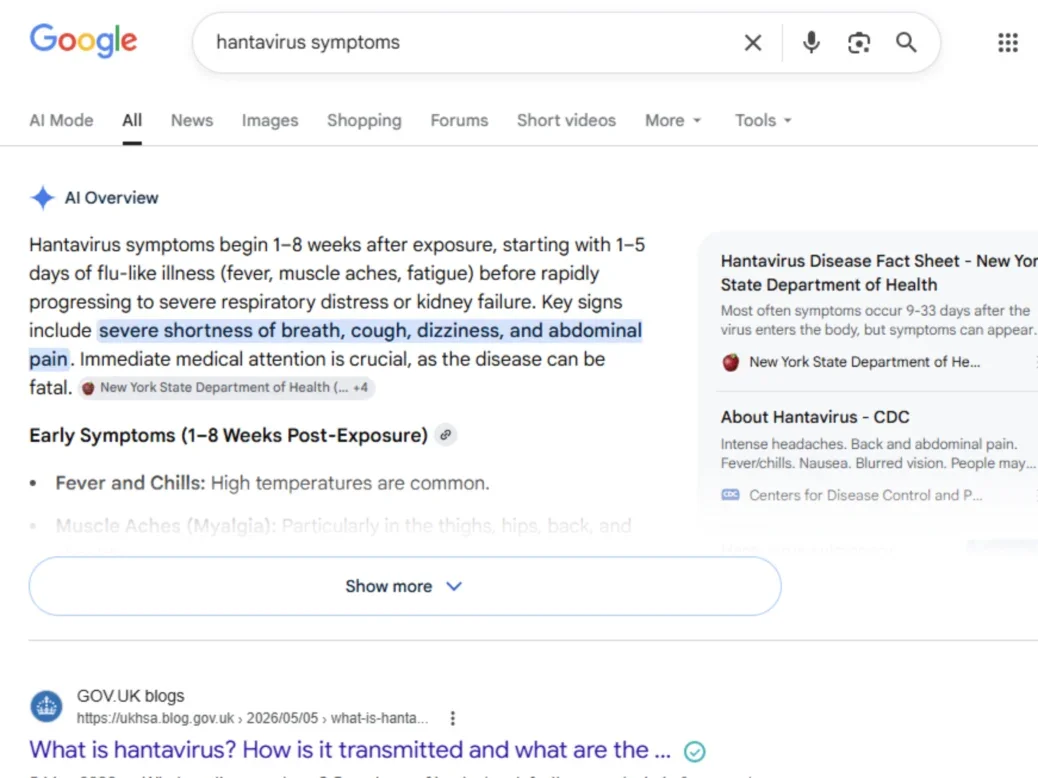
Health is the topic vertical most vulnerable to losing clicks as a result of Google’s AI Overviews, according to new Sistrix data shared with Press Gazette.
Looking at data from three months at the start of 2026, Sistrix estimates that health sections on major news brands will have seen links to articles supplanted by an AI-written summary 72% of the time in Google search results.
Sistrix has found that for keywords where an AI Overview appears at the top of Google’s search results, the average rate of people clicking on the first search result drops from 27% to 11%, meaning a clickthrough decline of almost 60%.
Healthline was the fastest-falling major news website in the UK in March, losing 48% of its audience year on year according to Ipsos iris.
The second most heavily-affected vertical was tech (where AI overviews appear 47% of the time) followed by travel (39%), lifestyle (37%) and money (35%).
The most resilient topics appeared to be football (where AI overviews appear 5% of the time) and wider sport (9%), likely due to the nature of results and the fact Google does not deploy AI Overviews on breaking news.
Evergreen content appears to be more at risk from having to compete for eyeballs and clicks with a Google AI Overview. People Inc, which has seen traffic from Google to its brands drop by 63% in the past two years, is an example of a publisher focusing on moving away from evergreen content towards reporting new information.
The AI Overviews data was produced by Sistrix using its search visibility index which measures how visible websites are in Google search results.
The newsbrands included in the research were: The Guardian, Daily Mail, The Telegraph, The Times, The Independent, The Sun, the Mirror, the Express and CNN. Sistrix started with its list of the most visible news media brands in the UK in search, then excluded those without a usable site structure (where their URLs clearly mark the content type, for example, thetimes.com/travel).
Not all of the newsbrands used in the research were included in every topic breakdown because the research depended on Sistrix being able to identify a clearly defined subdomain for that vertical.
The date range of the research was 14 January to 24 April. The data is from the UK but Press Gazette understands it tracks closely with results from the US.
How can publishers limit the harm from AI Overviews?
Steve Paine, marketing manager at Sistrix, told Press Gazette: “The results here show that some topics carry much higher risk than others. If your business model relies on clicks from search, assess the exposure rate and consider focusing on low-exposure topics and niches.
“Health is a high-value topic and Google appears to want to take control of that. Other topics such as sports, that might be harder or more expensive for Google to track, have a much lower rate of exposure.
“My tip: Assess your AIO exposure rates and try to work as far ahead of an AI bot as possible, in low-exposure topic areas.”
SEO expert Barry Adams, of Polemic Digital, said: “Health queries are a popular category of searches, accounting for between 5% and 7% of all Google searches. As health queries are often complex, with users requiring information from multiple sources and centred around established medical consensus, they ostensibly lend themselves well to AI summaries.
“Google apparently trusts its AI to provide accurate summarised information in this area, more than in any other category of searches. In light of the inherently unreliable nature of AI summaries, this seems somewhat irresponsible. Hallucinations in LLM-generated answers are still common, and to rely on AI for crucial health information seems a leap of confidence that’s not entirely warranted.
“Query categories that are faster-moving and require new information on a regular basis, such as sport and television, are less suitable for AI summaries. This is reflected in lower rates of AI Overviews for these types of searches.
“This enforces the notion that publishers should move away from producing content that merely reflects established consensus, and instead focus on content that provides new information. Reporting the latest news and providing insightful analysis on it, regardless of category, appears mostly immune to AI summarisation.”
An NHS evaluation of Google AI Overviews said they were “often clear, accessible, and practically oriented” in response to patient-facing questions but sometimes missed important context or obvious sources.
The Guardian reported in January that Google AI Overviews put people at risk of harm from misleading health information. Google said in response: “We invest significantly in the quality of AI Overviews, particularly for topics like health, and the vast majority provide accurate information.”
Which newsbrands are most exposed to Google AI Overviews by content type?
Of the news sites analysed, only The Sun, The Independent and Daily Mail were included in the health analysis as they had clear category domains. The Sun had the greatest AI Overviews exposure in the health category, with an average of 87%, versus 70% for The Independent and 59% for Daily Mail.
The Sun was also the most exposed in tech coverage on 55%, followed by the Mirror on 53% and The Independent on 46%.
The Telegraph was the least vulnerable to AI Overviews overall, at 21% across the topics analysed, followed by CNN on 24%. The Sun was the most vulnerable, with exposure of 36%.
Sistrix data can also indicate how AI Overviews exposure has increased since the product’s 2024 launch.
The travel section of The Times (thetimes.com/travel) had exposure of 45% in mid-April, according to Sistrix, and peaked at 53% in December.
The Independent’s news content (with URL beginning independent.co.uk/news) had exposure of 26% in mid-April.
Reddit.com in the US has steadily increased over the past six months to exposure in search results of about 46%.
Email pged@pressgazette.co.uk to point out mistakes, provide story tips or send in a letter for publication on our "Letters Page" blog
